Twinedge
Partner
Field
Duration
Roles
Context.
Three PhDs. Deep domain credibility. Technology that works. And a pitch that was losing non-specialists.
Drug development fails expensively and late. Most attrition happens because the right patient population for a given therapy was never properly identified before millions were committed to large clinical trials. TwinEdge was founded to fix this by simulating cancer patients digitally so pharma companies can identify the right trial population before additional patients are enrolled.
The founding team, three PhDs with backgrounds at Merck Serono, Crown Bioscience, and JSR Life Sciences, had the scientific depth and the technology. What they needed was a way to make it legible to the people who didn't.
Malpaux invested in TwinEdge at pre-seed because we understood what we were looking at. That same technical understanding is what made the communication work possible.
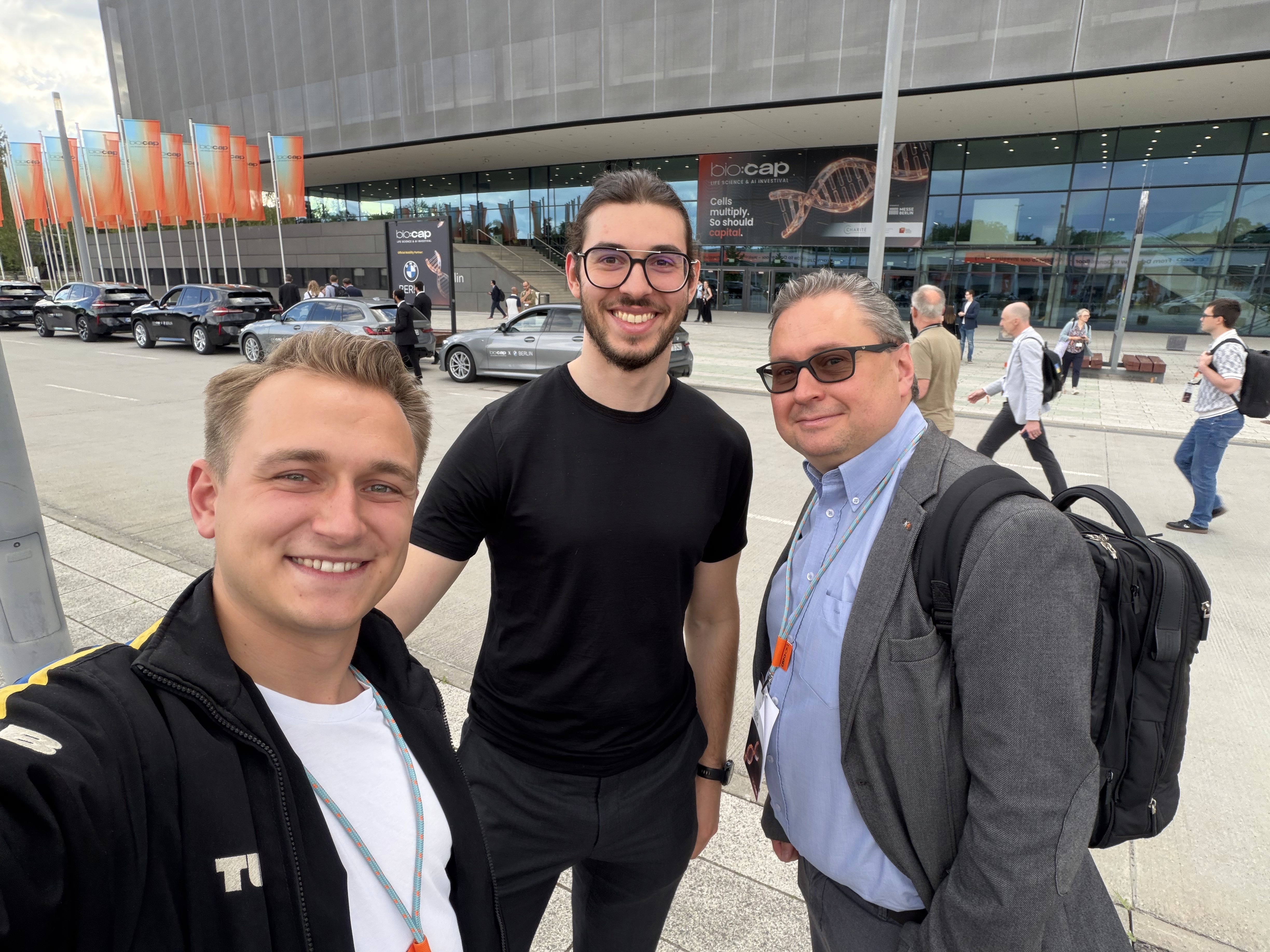
Here is us with Kevin from TwinEdge at the bio:cap 2026 in Berlin:
Why this.
The current clinical trial system enrols patients into trials that were never likely to help them. TwinEdge had a scientifically credible starting point to try to fix that.
Problem.
When Malpaux first encountered TwinEdge, the science and technology were credible. However, their strong scientific identity also made them inaccessible for technical laypeople, investors and family offices. The pitch was dense with technical content that rewarded close reading but lost most rooms before the differentiation landed.
Constraints and complexity.
A technically dense domain with a burned audience. The in silico platform space, computational approaches to drug development, has seen repeated overpromising. The communication had to be specific enough to be credible to scientists while careful enough not to trigger the scepticism of commercial buyers who had already been sold things that didn't deliver.
Differentiation that lives in the technical details. TwinEdge had a defensible competitive moat: population-scale mechanistic depth, without the physical lab infrastructure or large proprietary datasets that competing approaches depend on. That differentiation only becomes visible once you understand what the alternatives actually require. Making it legible without a biology PhD in the room was the core communication problem.
Pre-seed constraints. At this stage, the deck and the founders are almost the entire case to many investors. There was no product revenue, no large commercial partnership, no press coverage to do the interpretive work. The communication had to carry more weight than it would at a later stage.
What we did.
Malpaux invested at the pre-seed stage and worked alongside the TwinEdge founders on communication strategy and a full pitch deck redesign.
Communication strategy. We restructured the narrative from the ground up: opening with the problem in terms any non-specialist could hold, moving through the mechanism at the level of detail needed to establish credibility without losing the room, and landing on the differentiation claim with enough specificity to survive scrutiny. Their case study evidence, market entry logic, and team credentials were sequenced to reinforce each other rather than compete for attention.
Pitch deck rework and redesign. Content and visual redesign were developed together, not in sequence. The structure of each slide was determined by what it needed to communicate. The design was built to reduce the interpretive work a first-time reader has to do, and to give the founders a cleaner surface to present from.
Outcomes.
TwinEdge closed their first commercial project and has a pipeline of over 30 qualified partners across pharma and biotech, non-clinical CROs, biospecimen providers, and clinical CROs. Multiple beta-testers are in active projects.
The redesigned deck was used to pitch at bio:cap 2026. It helped facilitate multiple investment offers, including a VC term sheet. The company is now raising their first official round, with a communication system that has already proven it can carry the case.
Lessons.
Founders can't unsee what they've built. The closer someone is to the science, the harder it is to remember what it felt like not to understand it or what an outside party would find most compelling. It helped that we weren't simulating the investor's point of view. We are investors. The questions we asked about the pitch were the same ones we ask when evaluating a company ourselves.
Deep tech communication requires fluency in both directions. Sharpening TwinEdge's pitch wasn't a design problem that happened to involve science, or a science problem that happened to need better slides. It required genuine understanding of the underlying technology and the design and communication capability to translate that understanding into something a non-specialist could hold in two minutes. One without the other produces either technically accurate material that loses the room, or accessible material that doesn't survive scrutiny.
The deck is a product. A pitch deck is a system that has to work both with the founders in the room and without them. Structure, sequencing, and visual clarity determine whether the right people keep reading. Those decisions are product decisions, and they benefit from the same integrated thinking across content strategy, information architecture, and design that Malpaux brings to product work.
Early conviction requires early understanding. Malpaux invested in TwinEdge before the first round opened because we understood what we were looking at. That understanding came from the same technical depth that made the communication work possible.